

Financial independence in your 30s isn’t a fantasy—it’s a plan. With aggressive saving, smart investing, side income, and discipline, you can replace paycheck dependence years earlier than most people think. Here’s the complete roadmap to get you there.
Why financial independence in your 30s is possible (and powerful)
Time is on your side: starting in your 20s/early 30s gives compounding maximum runway.
Fewer lifestyle anchors: no heavy mortgage or dependents makes aggressive saving easier.
Freedom = options: you can change careers, start a business, travel, or retire early.
Core concept: What “financial independence” means
Financial Independence (FI) = having sufficient passive/portfolio income or savings to cover your living expenses without needing traditional employment.
Common rule of thumb: the 4% safe withdrawal rate → need ~25x your annual expenses.
$40,000 annual expenses → target FI portfolio ≈ $1,000,000.
Step 1 — Define your target (the numbers matter)
Calculate true annual spending (live-it-forward method):
Essentials: housing, food, transportation, insurance, utilities.
Lifestyle: travel, dining out, subscriptions, hobbies.
Choose a FI target:
Lean FI: 20x annual expenses
Standard FI: 25x annual expenses (4% rule)
Comfortable FI: 30x annual expenses
Quick examples:
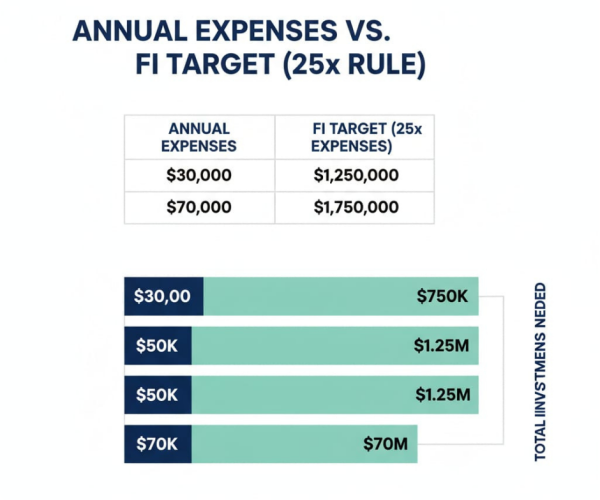
Annual expenses $30k → FI ≈ $750k (25x)
Annual expenses $50k → FI ≈ $1.25M (25x)
Step 2 — Reverse-engineer the timeline (savings rate is the driver)
Key insight: years to FI ≈ a function of savings rate (income after tax that you save + invest).
Save 50% of income → reach FI in ~17–20 years.
Save 70% of income → reach FI in ~7–10 years.
Save 80–90% → reach FI in 4–7 years.
Concrete plan for a 10-year FI target in your 30s
Example: Age 25, want FI by 35; salary $80k net (after tax).
Target portfolio: $40k expenses → need $1M.
Current savings: $20k.
Annual return assumption: 7% real.
Annual savings needed: roughly $60k/year over 10 years (use compound calculator).
If unrealistic from salary alone, supplement with side income.
Step 3 — Maximize your saving rate
Automate savings: paycheck → emergency fund → retirement accounts → taxable investing.
Live below your means deliberately.
Optimize housing (roommates, lower-cost city).
Reduce recurring costs.
Funnel windfalls straight to investments.
Step 4 — Attack high-cost debt
Prioritize high-interest debt.
Compare student loan/mortgage rates vs. expected investment returns.
Refinance where beneficial.
Step 5 — Invest intelligently (compounding is the engine)
Start with tax-advantaged accounts:
Employer 401(k) (capture full match).
Roth IRA.
HSA (if eligible).
Then fund taxable brokerage.
Favor low-cost broad-market ETFs and index funds.
Sample allocation:
80% equities
10% bonds
10% alternatives / real estate
Rebalance annually and reinvest dividends.
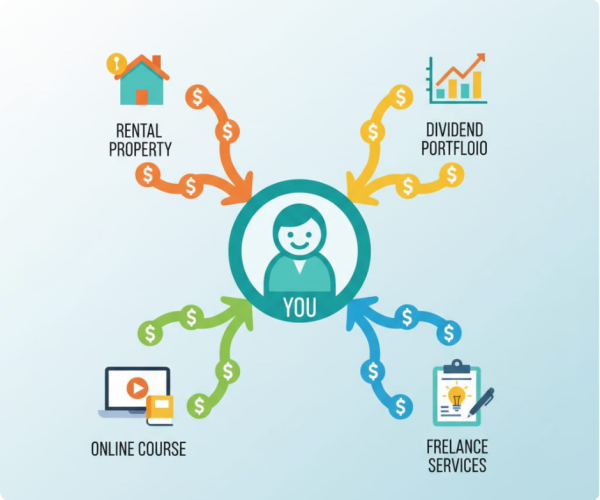
Step 6 — Build diversified passive income sources
Rental real estate
REITs
Dividend ETFs
Scalable side hustle
Digital assets (courses, e-books)
Diversify so portfolio withdrawals aren’t the only income source.
Step 7 — Use leverage carefully
Leverage accelerates returns but increases risk.
Maintain 6–12 months emergency fund if heavily leveraged.
Step 8 — Optimize taxes and legal structure
Maximize retirement accounts and use tax-loss harvesting for taxable accounts to keep more of your investment returns compounding over time. Smart tax planning can significantly accelerate your journey toward financial independence in your 30s by reducing unnecessary liabilities and increasing net investable income.
Consider tax-efficient fund placement (bonds in tax-deferred accounts, equities in taxable accounts).
If business income grows, use legal entities (LLC, S-corp) to optimize taxes and liabilities — consult a CPA.
Step 9 — Protect your progress
Emergency fund: 3–12 months depending on job stability.
Insurance: health, disability (critical if you’re the primary earner), life (if dependents).
Estate documents: will, power of attorney, beneficiaries.
Regular check-ins: quarterly net worth tracking and annual financial plan review.
Step 10 — Mindset, habits, and lifestyle design
Reframe: see saving as “paying future you” for time and freedom, not deprivation.
Commit to “mini-retirements” or sabbaticals to avoid burnout.
Community: surround yourself with like-minded peers (FIRE communities, accountability groups).
Continuous learning: read widely (investing, tax strategy, negotiation) and iterate.
5-Year Roadmap to FI in your 30s (practical milestones)
Year 0 (Now): Audit finances, set true expenses, open accounts, start automation, build 3-month emergency fund.
Year 1: Eliminate high-interest debt, increase savings rate to 30–50%, maximize employer match.
Year 2: Ramp up side income to add 10–30% to annual savings, start real estate or small business experiments.
Year 3: Reevaluate allocation, scale taxable investments, optimize taxes, maintain 6 months’ liquidity.
Year 4–5: Approach 25x expenses target, scale passive income, legally structure assets and protect wealth.
Common pitfalls and how to avoid them
Chasing returns / market timing: stick to a plan and a diversified portfolio.
Lifestyle inflation as income grows: enforce rules (e.g., 50% of raises to savings).
Overconcentration in employer stock: diversify for safety.
Neglecting relationships and health in the pursuit of FI—balance is crucial.
Tools, calculators & resources
Compound interest calculator (for projections)
FIRE calculators (e.g., cFIREsim, FIRECal c)
Budgeting tools: YNAB, Mint, Personal Capital
Books: Your Money or Your Life (Vicki Robin), The Simple Path to Wealth (JL Collins), Early Retirement Extreme (Jacob Lund Fisker)
Conclusion:
Achieving financial independence in your 30s is possible with disciplined saving, smart investing, side income, and careful planning. Start early, follow a clear roadmap, protect your progress, and stay consistent — small steps compound into long-term freedom and options for your life.
Disclaimer
I’m not a licensed financial advisor. This post is educational and not personalized financial advice. Consider your personal situation and consult a professional for tailored planning.
Leave A Comment