


You don’t need thousands of dollars to begin building wealth — you only need $100 and the right plan. Here’s exactly how to turn that spare $100 into a foundation for long-term investing.
Investing often feels out of reach when you’re starting with small amounts. The good news: modern brokerage features (fractional shares, commission-free trades, low-minimum ETFs and robo-advisors) let you begin with very little. This guide walks you through realistic, actionable steps to start investing with $100 — including how to prioritize emergency savings, where to put that money, what allocation makes sense, and how to scale up.
Quick overview (what you’ll learn)
Should you invest that $100 now or save it as an emergency buffer?
Best platforms and tools for small-dollar investors
Simple portfolio allocations for $100
Dollar-cost averaging and compounding explained
Common mistakes and how to avoid them
Disclaimer
I’m not a licensed financial advisor. This article is educational — not personalized investment advice. Investing involves risk, including loss of principal. Consider your goals, timeline, and risk tolerance before investing.
Step 1 — Check your emergency buffer and short-term needs
Before investing, make sure a small emergency buffer exists. If you have credit card debt with high interest or no emergency fund, prioritize:
High-interest debt payoff (credit cards)
A small emergency fund ($500–$1,000) if you have no savings
Why: Market volatility can force you to sell investments at a loss if emergencies arise.
If you already have a reasonable short-term cushion, investing $100 makes sense.
Step 2 — Choose the right account type
Decide which account suits your goal:
Taxable brokerage account: Best for general investing and flexibility.
Roth IRA (if eligible): Great for retirement — contributions grow tax-free and withdrawals in retirement are tax-free.
Traditional IRA: If you want tax-deferred contributions.
If you want retirement savings and qualify for a Roth IRA, consider starting there. If you prefer maximum flexibility, open a taxable account.
Step 3 — Pick a platform that supports small-dollar investing
Look for platforms with:
Fractional shares
No minimums or low minimums
Low or no commissions
Good mobile UX and educational tools
Popular options:
Fidelity
Charles Schwab
Vanguard
Robinhood
Webull
M1 Finance
Betterment
Wealthfront
SoFi Invest
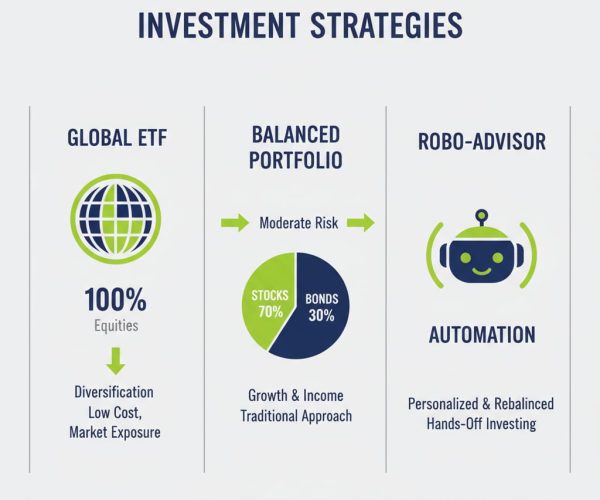
Step 4 — Decide on an investment strategy (3 simple approaches)
Pick one of these beginner-friendly strategies based on how hands-on you want to be.
A. One-and-done core ETF (lowest maintenance)
Put $100 into a single low-cost, diversified ETF (e.g., VTI — Vanguard Total Stock Market ETF, or a broad S&P 500 ETF like SPY or VOO).
Why: Instant diversification across thousands of stocks for a tiny cost.
B. Mini diversified portfolio with fractional shares (balanced exposure)
Split $100 across 2–3 ETFs or funds:
70% stocks (Total Stock Market ETF or S&P 500)
30% bonds (Total Bond Market ETF like BND or AGG)
Example: $70 VTI + $30 BND
C. Robo-advisor or automated pie (fully hands-off)
Use M1 Finance or a robo-advisor (Betterment/Wealthfront) to create an allocation. They’ll manage rebalancing and reinvest dividends.
Good for people who want automation and advice without stock-picking.
Step 5 — How to Start Investing with $100 Using Fractional Shares
Fractional shares let you buy a piece of an expensive stock (e.g., Amazon) or ETF in any dollar amount. With $100 you can:
Buy $50 of a total market ETF, $30 of an international ETF, $20 of a bond ETF
Or split across individual stocks and ETFs for diversification
This approach allows beginners to start investing with $100 while still achieving diversified exposure, even on a small budget.
Step 6 — Dollar-cost averaging (DCA) vs lump sum
Lump sum: Investing the full $100 now captures market growth immediately (historically has performed slightly better than spreading out).
DCA: Invest small amounts regularly (e.g., $25 weekly/monthly). Reduces timing risk and builds the habit.
Recommendation: If the $100 is all you have, invest it now. If you can invest regularly, set up automatic transfers.
Step 7 — Reinvest dividends, avoid high fees
Turn on dividend reinvestment (DRIP) so dividends buy more shares automatically.
Avoid funds and accounts with high expense ratios. Look for ETFs with expense ratios <0.10% for broad market funds.
How a small amount compounds — simple examples
One-time $100 invested at a 7% annual return:
10 years ≈ $196
20 years ≈ $387
30 years ≈ $760
Monthly $100 contributed for 30 years at 7% ≈ $139,000
These examples show that a one-time $100 is modest, but the real power is consistency. Start small and build recurring contributions.
Sample $100 portfolio ideas (ready-to-use)
Conservative (lower volatility):
$70 BND (bond ETF) + $30 VTI (stock ETF)
Balanced:
$50 VTI + $30 VXUS (international ETF) + $20 BND
Aggressive (growth-focused):
$100 VTI or split $70 VTI + $30 QQQ (tech-heavy)
Dividend tilt:
$60 VTI + $40 VIG (dividend growth ETF)
Tips to scale up and build momentum
Automate micro-investing: Set $5–$25 automatic transfers weekly.
Reinvest bonuses: Funnel tax refunds, gifts, or side gig income into investing.
Increase contributions over time — aim to raise your monthly amount by 1% of income each year.
Common beginner mistakes (and how to avoid them)
Chasing hot stocks or “get-rich-quick” tips: Stick to low-cost broad funds first.
Ignoring fees: A 1% higher fee can significantly erode returns over decades.
Selling during dips: Market volatility is normal. Have a plan and stick to it.
Not checking taxes: Be aware of taxable events if you frequently trade in a taxable account.
Resources and tools to get started today
Brokerage choices:
Fidelity, Vanguard, Schwab, Robinhood, M1 Finance, Betterment
ETFs to consider:
VTI, VOO, SPY, VXUS, AGG, BND, BNDX
Calculators:
Compound interest calculator
Books for beginners:
The Little Book of Common Sense Investing (John Bogle)
A Random Walk Down Wall Street (Burton Malkiel)
Actionable 10-minute start checklist
Open an account (Roth IRA or taxable) at a low-cost broker.
Link funding method (bank account).
Decide allocation (pick one of the sample portfolios above).
Buy your first $100 of ETFs or enable fractional shares and split the amount.
Turn on automatic contributions (even $5/week).
Enable dividend reinvestment.
Save or pay down high-interest debt alongside investing.
Bookmark a compound interest calculator to track milestones.
Read one beginner-friendly investing article or chapter each week.
Revisit your allocation annually and increase contributions when possible.
Final thoughts — small starts compound into big outcomes
Starting with $100 is meaningful. It builds the habit of investing, teaches discipline, and gets you into the market. The most important actions are getting started and making consistent contributions.
Even if it feels small, anyone can start investing with $100 and over time watch their contributions grow significantly. Time and discipline beat short-term market timing.








Leave A Comment